Hiroshima
The next day, we took the Shinkansen to Hiroshima. This is a high-speed training that can basically take you all across Japan in a shockingly short amount of time, traveling at speeds of up to 200 mph/320 kph, kind of like the German ICE! And you wouldn't know it based on how smooth the ride is. The seats are comfortable and recline, and you can even order drinks or snacks if you are in the Green Car (which is kind of a first-class type thing), and of course you have Wifi. The scenery is really cool, but you're moving so fast and there are so many tunnels that it's kind of hard to see everything. We didn't get to see Mount Fuji because it was cloudy, but the landscape of Japan is stunning. It's mountainous with villages strewn throughout, and all the mountains are covered in trees. It took about 4 hours to get from Tokyo to Hiroshima, which is a whopping 800 km/500 miles! We arrived in Hiroshima towards the evening, checked into our hotel, and picked a bistro for dinner. I ended up taking us to the wrong restaurant, which was a fortuitous mistake because we ended up eating at a very local little restaurant (that fit maybe 10 people in it), with delicious food! Granted, walking in felt a bit like a record-scratch moment where everyone stopped talking and stared at us, but they were very friendly and between their broken English and Claysie's broken Japanese, we managed to order and had a really nice time!


The next day, we went to the Peace Museum, which was one of the things I really wanted to do. I will take on a more somber tone here because talking about that experience requires it. To me, the decision to drop the atomic bomb on Hiroshima is one of the most heinous acts ever committed in human history. Conceptually, I understand that the leadership of the USA felt it was necessary to prevent further loss of countless lives on both sides. However, the fact that it was dropped on a civilian population, and that a second bomb was dropped, is mind-blowing to me (again, I understand that the refusal of the Japanese leadership to surrender triggered the second bomb). And so I always wanted to go to Hiroshima to see and try to understand.
And if anything, my visit to the Peace Museum made the event even more incomprehensible to me. We learned that Hiroshima was targeted specifically because it offered the best conditions to maximize the impact of the bomb (weather, geography and population). While it was a military hub, the chosen target location was in the center of the civilian population (it was a bridge that was easy to identify and target) in the middle of the city, not along the outskirts where the Japanese navy was clustered. It was also selected as, at the time, it was thought to not have any American prisoners of war (which turned out not to be the case as 12 American soldiers were there that had been rescued from a ship that had been sunk nearby). One of the museum guides said that the bomb was dropped to serve as an experiment to observe and study the impact of a nuclear bomb and how it interacted with the environment and humans. I cannot realistically describe the horrors of what occurred on that day or even what I learned, but I will try to at least give a pale imitation of it. I do think anyone who can should experience it for themselves, as to me it's just as horrible a tragedy as what happened in the concentration camps in World War 2, if at a smaller scale. Pictures of the museum are not permitted.
The bomb was dropped on August 6, 1945 at 8:15 AM. I know this because the museum had several clocks that were recovered from the ruins of houses and had that time immortalized on them forever. What you may not know is that most of Japan had been bombed into oblivion, including many of the major cities like Tokyo and Kyoto, leaving little but rubble. Hiroshima was untouched by the bombing runs, which we now know was because it was a potential target for the atomic bomb. But as the Empire of Japan refused to surrender, the decision was made to drop the bomb. A single bomber was seen in the sky that day in Hiroshima, which was not considered much of a threat as it was just one plane. The bomb (nicknamed Little Boy) detonated about 600m/1900ft above the ground, releasing a blast wave that instantly vaporized tens of thousands of people. The temperature from the initial blast was 7,700 degrees Celsius (~14,000 degrees Fahrenheit). To give you a sense for what that means, the temperature at the surface of the sun is about 5,500 degrees Celsius. The map below from BBC shows the different impact zones of the blast.
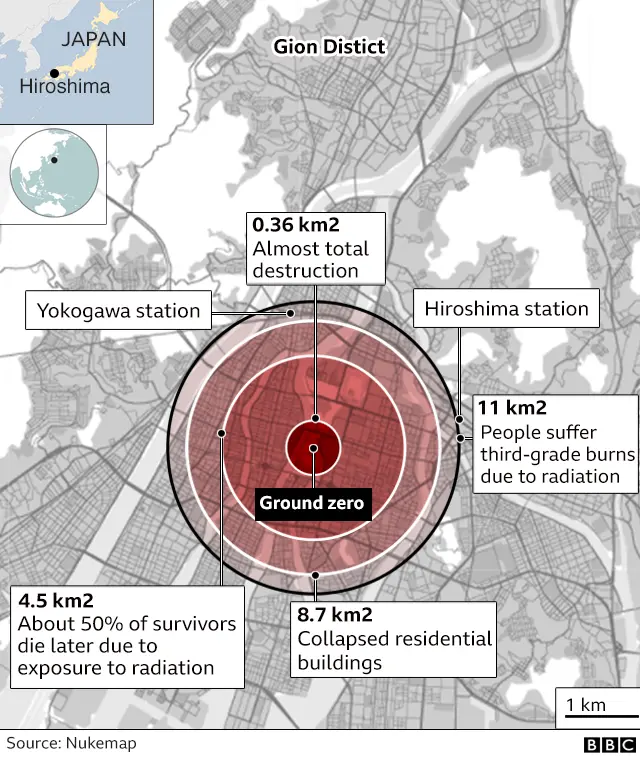
If you weren't vaporized immediately, the wind from the blast traveled at about 445 meters per second/1,000 miles per hour. Again, for comparison consider a category 5 hurricane has wind speeds of about 160 miles per hour. So, the wind destroyed most buildings immediately, killing many people and burying survivors in rubble, many with horrible burns all over their bodies. And an intense inferno burned across the entire city, forcing parents to leave their children behind or vice versa to escape the fire. Many jumped into the river, which was completely inundated with corpses. Many of those who survived the initial blast, collapse of houses and raging fire and didn't drown in the river later died from extreme exposure to radiation. The images of charred corpses or people with horrible radiation burns were horrendous. Black, slick, oily rain fell from the sky, in an image that must have seemed like death coming down from the heavens. The museum displayed glass bottles or caps melted into a giant clump. A piece of stone has the outline of a human shadow where the physical body of the person absorbed the blast, leaving an imprint in the stone.
It is estimated that more than 150,000 people died from the bomb, whether from the immediate blast or from radiation. Survivors were ostracized from society and many ended up committing suicide long after the bomb was dropped. Families were torn apart, and survivors were never able to go back to a normal life, forever fearing that one day they would wake up and develop a disease or suffer from the long-term effects of radiation.
One of the few remaining buildings from the bomb was the Genbaku Dome, which is known as the Peace Memorial. The main reason the building survived was because it was almost exactly underneath the impact point and was made of sturdy materials that were able to resist the downward force of the blast. But, the copper roof was melted off, leaving a hauntingly beautiful scaffolding. It is a truly awesome sight that will forever be carved into my memory.


As with so many horrendous tragedies, there was a silver lining, which Claysie symbolized beautifully with this image of the sun setting behind the dome.

There was a young girl that survived the Atomic bomb, named Sadako Sasaki who was two years old at the time of the bombing. She has a sad story that you can read about on Wikipedia. She was in and out of hospitals throughout her life, eventually developing and sadly succumbing to Leukemia when she was 12 years old in 1955. She had heard a story that folding 1,000 paper cranes would grant a wish, and she folded more than 1,400 cranes, wishing for recovery. After hear death people all around the world folded and sent paper cranes to the Peace Monument, totaling over 10 million cranes per year! If you visit Hiroshima, you will see these hanging all around the city, even being made into paintings. It is a beautiful and heartwarming story set in the backdrop of horror, tragedy and atrocity. Whereas the people of Hiroshima could easily have turned to hate and anger (and would have been completely justified in doing so), they instead focused on peace and love, ensuring nothing like this would ever happen again, to any people in the world.


The Flame of Peace is a perpetually burning flame that will stay lit until the last nuclear weapon in the world is destroyed, something for us all to hope and fight for.


Comments
Post a Comment